Dak'Art 2026: Art, Power and Public Space in a City in Transition
Who speaks, who looks, and who stays out of frame during the Dakar Biennial?
5/27/20268 min read
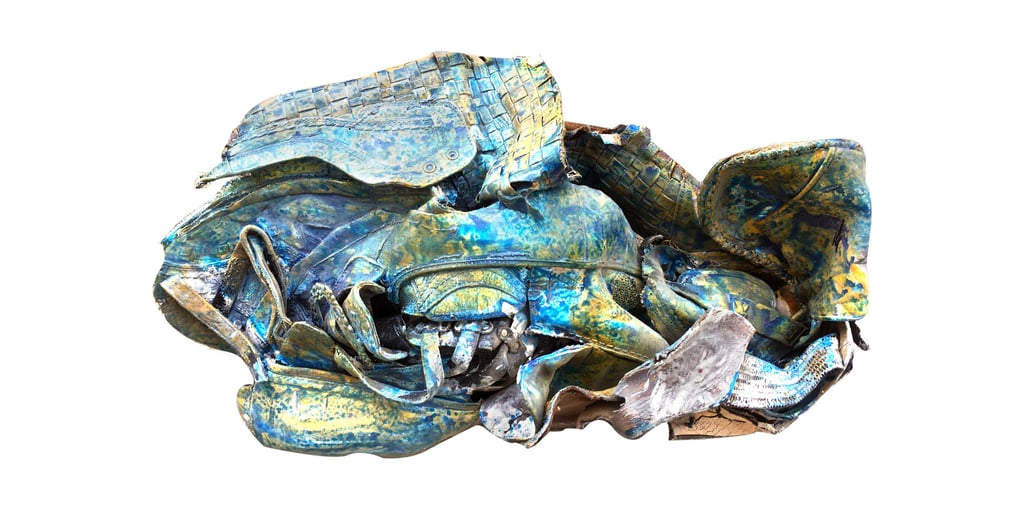
Every two years, Dakar, the capital of Senegal, becomes the stage for Dak’Art, one of the most important biennials for contemporary African art. What unfolds during those weeks goes far beyond a series of exhibitions. It is a moment when the city makes its artistic, political and social tensions visible. Artists open their doors, galleries organise vernissages, and curators, collectors and students move between official exhibitions and informal initiatives.
TEXT: SARAH AGYEMANG
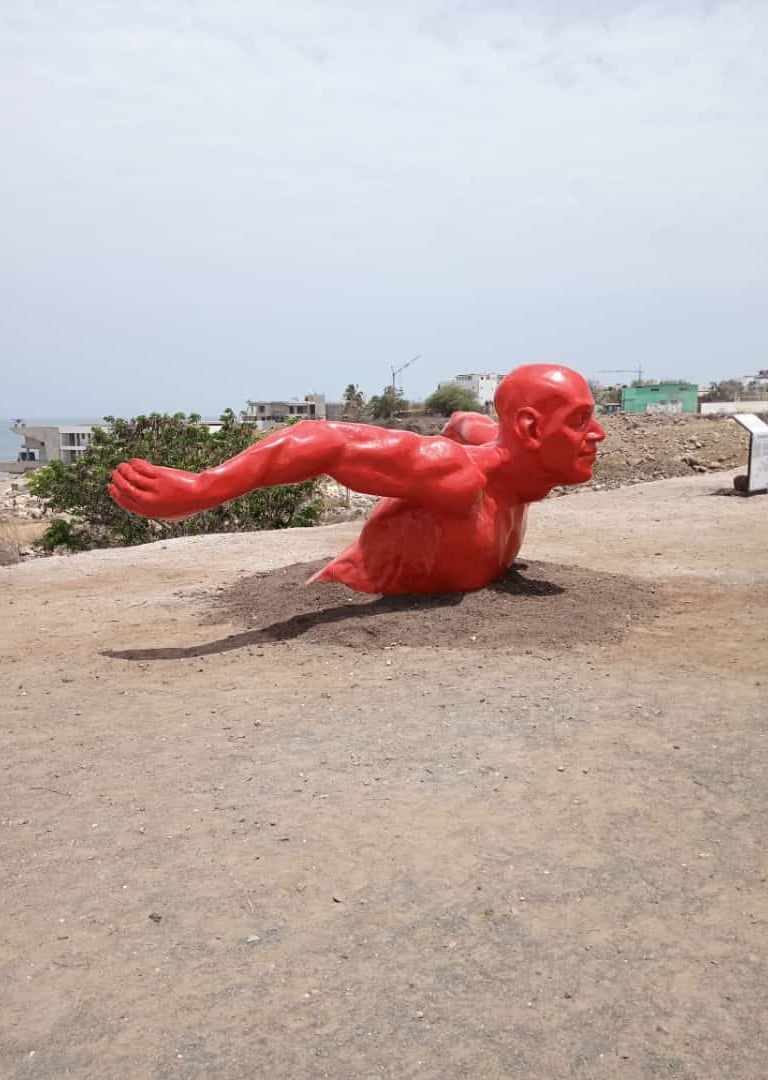
Achille Adonon, Visages, 2022. Photo: © Cyrille Gandaho, Courtesy of the Dakar Biennial 2022.
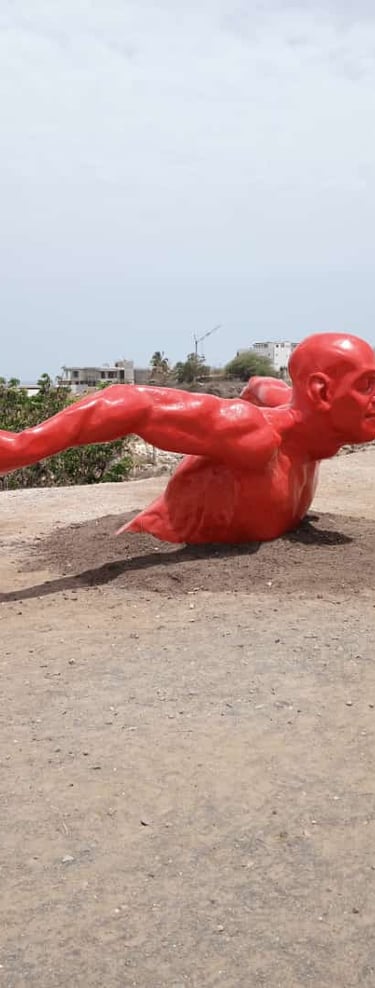
During Dak'Art, artists cast a bright spotlight on work that normally circulates quietly through studios, residencies and independent art spaces. But the biennial is not merely an art platform — it also temporarily reorganises the city itself. In that process, it becomes clear who speaks, who looks, and who remains out of frame. This dynamic does not play out within a single, uniform space, but within a field of tension between an official, institutionalised circuit and a more diffuse, city-wide OFF-circuit.
In Dakar, art and politics have always been closely intertwined. Since independence in 1960, culture has occupied a central place in Senegal's public life. Artists, writers and filmmakers actively shaped debates about identity, modernity and the future of Africa. Within that history, Dak'Art holds a particular position. Since the 1990s, the biennial has grown into a vital meeting point for contemporary African and diaspora art — a platform where artistic imagination, political history and international art circulation converge.
The 2026 edition takes place against a backdrop of political and social change. Senegal is navigating a period of high expectations, budgetary pressure and growing social unrest. The election of Bassirou Diomaye Faye as president and Ousmane Sonko as prime minister in April 2024 represented, for many, a new political momentum in a country with a strikingly young population. According to UN figures, approximately 75 percent of the population is under 35. Economic uncertainty and unequal access to opportunity weigh heavily on daily life.
In recent years, tensions have surfaced again in student mobilisations at the Université Cheikh Anta Diop — historically a centre of intellectual and political resistance. The demands are still familiar today: better infrastructure, payment of student grants, greater prospects and stronger political accountability. When young people take to the streets, they become part of a movement in which political awareness, intellectual debate and cultural expression are inseparable. Protest here is not simply resistance — it is also a form of participation and historical memory.
Against that backdrop, Dak'Art takes on a particular charge. The biennial becomes a public space in which the tensions, expectations and imaginings of Senegalese society are made visible. The question is not only what is shown, but also for whom — and from what position.
Diadji Diop, Doxantu, 2022. Installation. Courtesy of the Dakar Biennial 2022.
THE PARADOX OF SENGHOR
The city's cultural infrastructure is closely bound to Léopold Sédar Senghor — poet, Senegal's first president, and co-founder of the Négritude movement. For Senghor, cultural sovereignty was as essential as political independence. Art and culture were to play a central role in shaping a new African modernity. From independence onwards, he invested in a network of cultural institutions: the École nationale des arts, the Théâtre national Daniel-Sorano and the Manufactures Sénégalaises des Arts Décoratifs in Thiès, among others. With the Festival Mondial des Arts Nègres in 1966, this project gained international reach, establishing Dakar as a centre of artistic and intellectual exchange.
In the 1970s, a critical artistic scene emerged that did not fully identify with that state project. The collective Laboratoire Agit'Art — including sculptor Issa Samb, filmmaker Djibril Diop Mambéty and playwright Youssoupha Dione — developed alternative artistic practices through performances and interventions in public space. Art was conceived as something that cannot be contained within institutional frameworks, but arises in direct relation to social and urban life. "They placed art back at the heart of what the city is, at the heart of politics, at the heart of what the people are," says Fatima Bintou Rassoul Sy. She is Programme Director at RAW Materials Company, an arts knowledge centre in the heart of Dakar that runs arts education programmes and offers residencies. As a curator, she is closely involved in the biennial.
Senghor's cultural project carried an important paradox from the outset. Although he built impressive cultural infrastructure and actively supported artists, his cultural vision was never firmly enshrined in law. No durable legal framework emerged to structurally protect or organise cultural policy. Many institutions were established through presidential decrees or personal initiatives rather than legislation, and their survival therefore remained heavily dependent on political will. When economic crises and structural adjustment programmes in the 1980s placed government budgets under pressure, much of the funding for culture disappeared. Institutions survived, but often lost their financial footing and their original purpose. Artists inherited an impressive cultural landscape — but without the means to sustain it.
That dual legacy — a richly developed cultural infrastructure on one hand, and a tradition of autonomous, informal artistic practice on the other — forms the backdrop against which Dak'Art took shape. The first edition, in 1990, was devoted to literature, with the ambition of alternating between literature and contemporary art. It took place in the presence of both former President Senghor and his successor Abdou Diouf, which underlined the symbolic and political weight of the project. Its limited success, however, led to a reorientation placing visual and contemporary art at the centre.
In 1996, the biennial took its current form as a platform for contemporary African art, positioning itself as an important node within the international art circuit while remaining rooted in a local artistic dynamic that does not fully lend itself to institutionalisation. "The biennial was organised by the state," explains Rassoul Sy, "but its energy came from the artist community of Dakar."
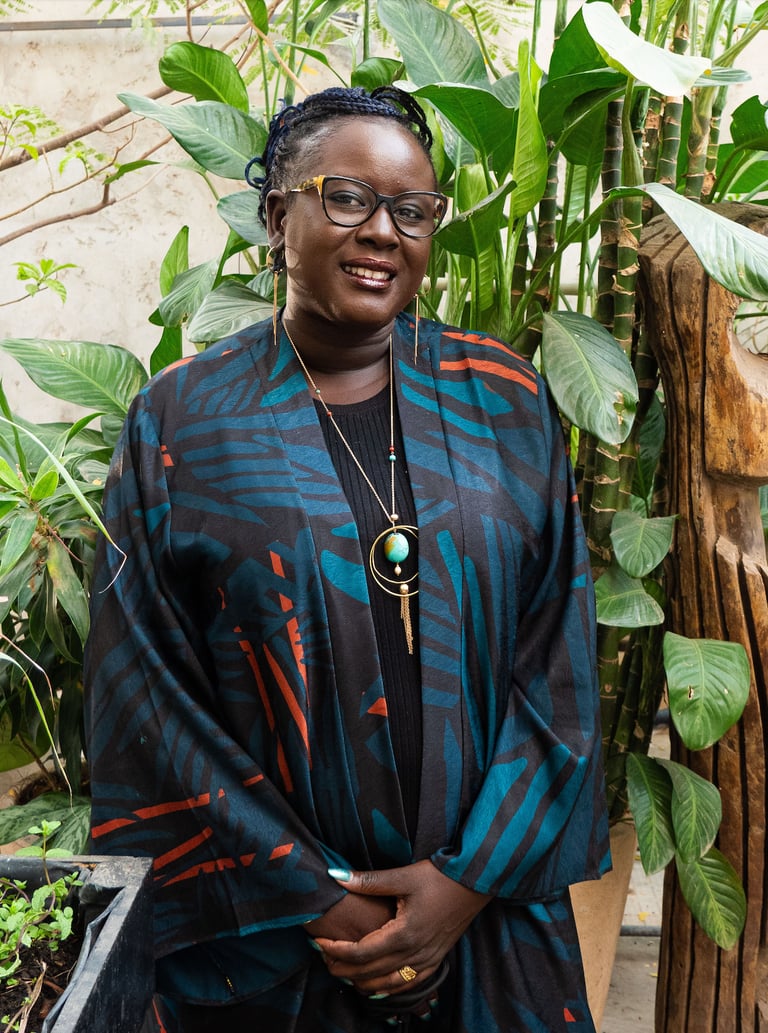
Fatima Bintou Rassoul Sy, January 2024. Photo: © Kerry Etola Viderot. Courtesy of RAW Materials Company
"The biennial was organised by the state, but its energy came from the artist community of Dakar."
— Fatima Bintou Rassoul Sy, RAW Materials Company
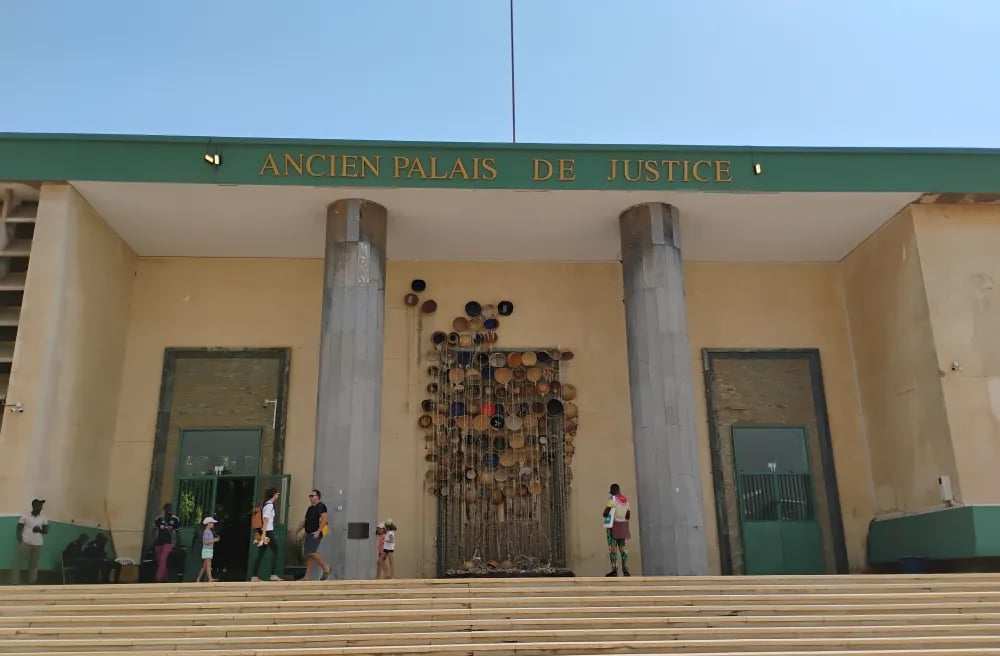
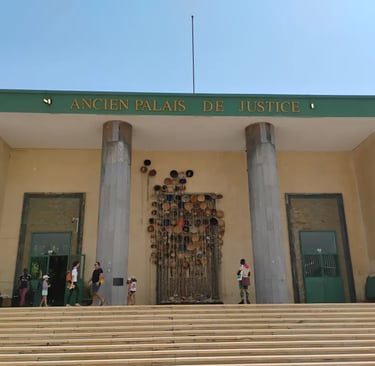
Gina Athena Ulysse, For Those Among Us Who Inherited Sacrifice, Rasanblaj!, 2024. Art installation, Ancien Palais de Justice, Dakar. Courtesy of the Dakar Biennial 2024.
THREEFOLD TENSION
In theory, Dak'Art presents itself as a space where questions of identity, history and decolonisation can be discussed publicly — but in practice, that openness proves unevenly distributed. "We could argue that it functions as a public space for cultural expression," says Dakar-based art researcher Delphine Buysse, carefully. "But it is a limited public space — not a fully inclusive one."
Access to the biennial is shaped by education, language — with a dominance of French and English — familiarity with contemporary art codes, and access to cultural networks. Artists from Dakar without entry to those networks, and practices that resist fixed categories — such as craft-based, informal or spiritual forms — often remain under-represented. "Visibility," Buysse argues, "is the result of structural selection processes."
Dak'Art therefore does not address one homogeneous public, but operates across a field of overlapping and sometimes conflicting audiences. "The biennial carries a threefold tension," Buysse explains. "As an African platform, as a node within the international art circuit, and as a local event that reflects a particularly dynamic ecosystem."
That tension between international visibility and local accessibility surfaced in incidents involving young people who damaged works. An uncomfortable question was thereby exposed: if people do not recognise themselves in these spaces — or feel they have no place in them — how public are those spaces, really? The issue is not only about safety or respect for the works, but about their meaning and accessibility for the city's own residents. It is precisely in that tension that space opens up for alternative forms of participation and artistic expression, outside the formal structures of the biennial.
"The biennial carries a threefold tension — as an African platform, as a node within the international art circuit, and as a local event that reflects a particularly dynamic ecosystem."
— Delphine Buysse, art researcher
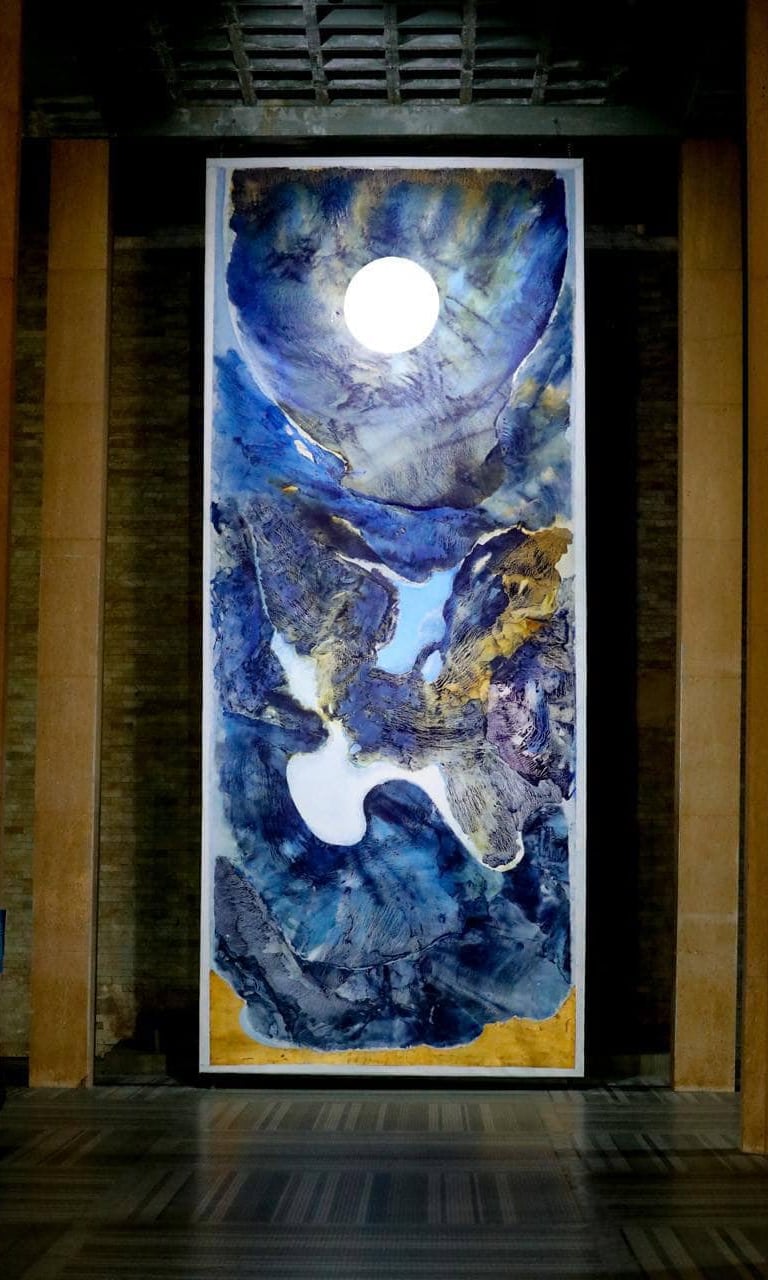
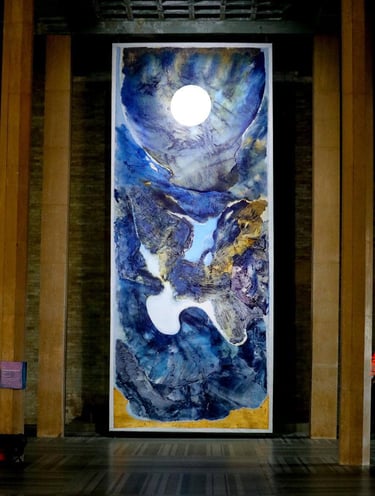
Abdou Ouologuem, Vibration, 2024. Art installation, Ancien Palais de Justice, Dakar. Courtesy of the Dakar Biennial 2024.
THE OFF-CIRCUIT
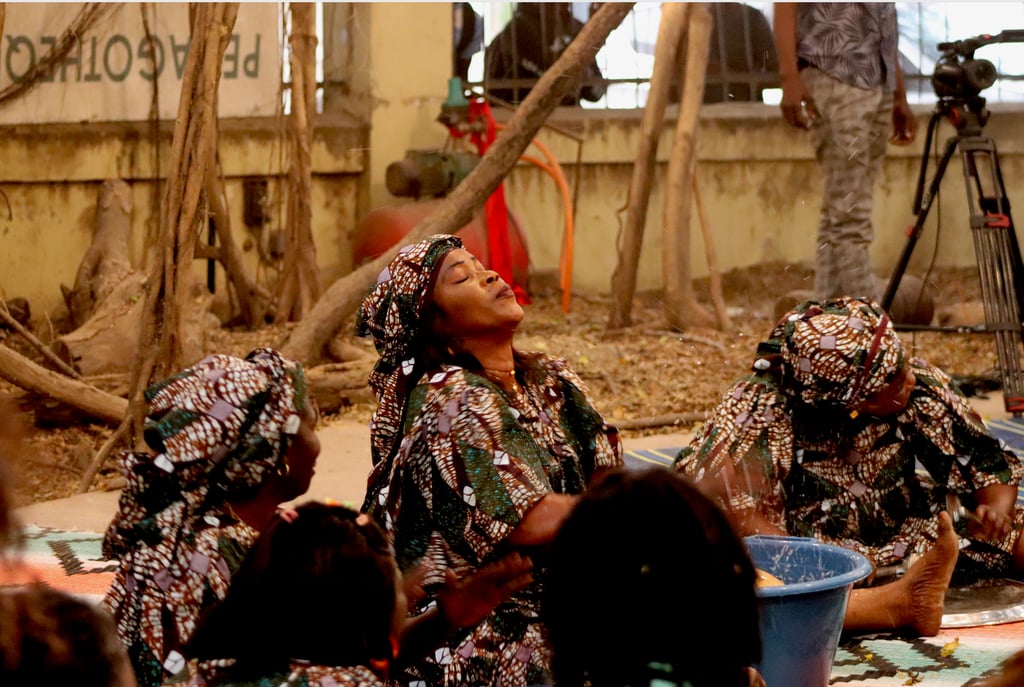
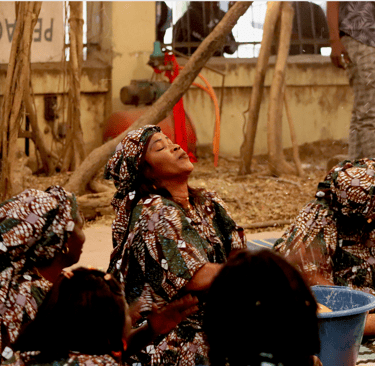
Dak'Art unfolds on two parallel levels: an official, institutionalised circuit, and a city-driven OFF-circuit.
The official circuit is organised by the Senegalese state and built around a defined framework. It operates within an international art logic in which selection, representation and legitimacy are central. Exhibitions are presented in museums and cultural institutions, with a clear artistic vision and an audience that often already moves within the art world. In this respect, the official circuit plays an important role in positioning Dakar internationally as a centre for contemporary African art.
Alongside it, the OFF-circuit has grown over recent decades into an essential component of the biennial. What began as a response to the limited space within the official programme has become a parallel infrastructure of exhibitions, initiatives and encounters spread across the city and beyond. The OFF-circuit is sustained by artists, gallerists and independent cultural organisations such as RAW Materials Company, Village des Arts and Atelier Céramiques Almadies. Cities beyond Dakar — Thiès, Ziguinchor, Saint-Louis and Kaolack — now organise their own parallel initiatives. Unlike the official circuit, the OFF-circuit follows no central selection process; it emerges from networks, collaborations and individual trajectories.
The OFF-circuit thus constitutes a space of greater artistic autonomy. It reveals how art in Dakar actually circulates — through informal networks, temporary exhibition spaces, private initiatives and conversations that partly escape official frameworks. "In the private sphere of the OFF-programme, questions can be asked and conversations can take place that are not possible in the international or official exhibitions, because those private spaces are not state-funded," explains Fatima Bintou Rassoul Sy.
Its dispersed character and often lower thresholds suggest the OFF-circuit connects more readily with a broader urban audience — but this space too is not free from social and cultural codes. The fact that art develops outside institutional structures does not automatically make it equally accessible to everyone.
Where the official circuit focuses on representation and international visibility, the OFF-circuit reveals how artistic practices organise themselves locally and acquire meaning. Together they form not a simple opposition, but a field of negotiation — one in which it becomes visible who participates in the biennial, and who does not.
Condition Report 5: A Sense of Place/Displacement, 2024. Photo: © Kerry Etola Viderot. Courtesy of RAW Materials Company.
"In the private sphere of the OFF-programme, questions can be asked and conversations can take place that are not possible in the international or official exhibitions"
— Fatima Bintou Rassoul Sy, RAW Materials Company
Editor's note: This article was originally published in Dutch in the MO* special edition on Artistic Freedom & Democracy (May 2026) and has been translated and edited for the English edition.*
Two captions were incomplete in the original print publication. The correct credits read: — Diadji Diop, Doxantu, 2022. Installation, Dakar Biennial 2022. — Achille Adonon, Visages, 2022. © Cyrille Gandaho, Dakar Biennial 2022.